






For others, a more detailed evaluation will be needed to identify the optimal strategy. This can be quantitative (e.g. determining the strategy that maximises the enterprise value based on corporate finance techniques) and/or qualitative (e.g. considering corporate expertise, trustee views and wider business plans).
Importantly, choosing a DB scheme strategy is not a one-off decision. Financial market conditions, regulatory developments and risk transfer market dynamics continue to evolve, meaning strategies should be actively monitored and revisited over time.
The sections that follow provide an overview of the different strategic options for sponsors, with insights from our experts on the key areas of focus from a corporate perspective. We then consider how companies can drive the execution of strategy, ensuring that the strategic objective is achieved in an efficient and controlled way.
Survey results

90%
of companies have defined a long-term strategy for their DB scheme.
35%
of companies would describe themselves as “very confident” that their chosen strategy is the right one.
This suggests that, for many sponsors, the challenge is no longer identifying a strategy but ensuring it remains the most appropriate as circumstances change.
Scheme size
Insurance buy-in/buyout
All scheme sizes
Superfund
>£25m in current market
Intentional run-on
Typically >£100m
SCHEME SIZE
FUNDING LEVEL
EMPLOYER COVENANT
Strategy selection
While many companies have seen DB scheme deficits turn into surpluses, others continue to commit material cash resources to address underfunded schemes.
Against this varied backdrop, establishing a clear and well-evidenced DB scheme strategy is a critical step for any corporate sponsor, providing an anchor around which key decisions can be made. There are now three primary long-term strategic options for companies sponsoring a DB scheme:
Buy-in/buyout with an insurance company
Transfer to a superfund
Intentional run-on
There are different flavours of these options and some specialist tools that can be used (e.g. capital-backed funding solutions or captive insurer arrangements), but we see these three options as capturing the likely long-term destination for most DB schemes.
Each of the above options have different implications for the corporate in terms of cost, risk and return. In some cases, the right strategy can be quickly identified based on a high-level assessment taking into account the individual characteristics of the scheme and the corporate, as shown below.
Overview

Lewys Curteis
Partner and Corporate Actuary
The UK defined benefit (DB) pension market has remained remarkably resilient over recent years, despite significant market movements and geopolitical shocks.
60%
Our latest analysis of the FTSE 350 companies shows around 60% of the DB schemes are fully funded on a buyout basis, with an aggregate buyout surplus of £40bn – a £10bn increase compared to the position last year.
This sustained improvement in funding positions has coincided with significant innovation in the DB market, which has expanded the strategic options available to corporate sponsors. The report that follows offers an overview of corporate DB scheme strategy in the current environment, providing insights on the main strategic options and the key components for effectively delivering strategy. Our analysis draws on our annual review of the pension obligations of FTSE 350 companies, alongside insights from a survey of 150 board-level executives responsible for DB pension decision-making.

Key areas of focus
Preparation is key
Strong preparation is essential to secure competitive pricing. Insurers favour schemes with clean data, clear benefits and efficient governance. Early data cleansing and resolving legacy issues reduces uncertainty and – when presented to insurers in the right way – will improve pricing. Alongside being “transaction-ready”, a clear plan for engaging with insurers in a dynamic, competitive market will maximise insurer engagement and the level of price competition that can be generated.
BUY-IN/BUYOUT
Increasing insurer competition and innovation
Competition is driving innovation, with insurers developing member focused add-ons to insurance policies, such as access to health and wellbeing benefits and the potential to share in the upside from favourable investment performance.
Cost management
Accounting impact
BUY-IN/BUYOUT
Smooth transition to buyout
BUY-IN/BUYOUT
Residual risks

Buy-in/buyout with an insurance company

Nikhil Patel
Head of Bulk Annuities
350+ transactions
Purchasing a bulk annuity contract with an insurance company remains the leading long-term strategic goal for corporate DB sponsors, with 50% of the respondents to our survey confirming this was the strategic goal for their DB scheme.
Over £200bn of DB pension liability has been transferred to the insurance market over the last five years, with a record 350+ transactions completed in 2025 alone.
For corporate sponsors, assuming the premium is affordable, this means there is a well-established route for settling DB pension liabilities in the insurance market. A buy-in is also the first step towards achieving buyout and wind-up, where the corporate can free itself fully from legacy pension risks.
Achieving a successful buy-in/buyout transaction requires careful planning and collaboration between the trustees, corporate and their respective advisers.
We have set out below some of the key areas of focus for corporates considering a buy-in/buyout transaction in the insurance market.
Transfer to a superfund

Jack Sharman
Head of DB Superfunds
Superfunds have emerged as a viable risk transfer solution for DB pension schemes seeking an alternative route to bulk annuities.
While still relatively new compared to insurance innovation, the superfund market has developed steadily in both structure and credibility.
At the time of writing, Clara has successfully completed five superfund transactions, with further deals expected in the near term. With the inclusion of a formal superfund regime in the Pension Schemes Act 2026 and new entrants known to be entering the market in the coming months, superfunds are becoming an increasingly mainstream risk transfer option for corporate DB sponsors.
70%
This growing interest is reflected in our survey results which showed that 70% of companies would consider transferring their scheme to an alternative risk transfer provider as a lower cost option than an insurance buyout, with 20% of companies actively considering this option.
Pricing
A key attraction for corporates is pricing.
Feasibility
Be prepared to navigate the Pensions Regulator’s (TPR) framework of “gateway principles”.
Innovation
The market is evolving to develop solutions for schemes in different circumstances
25%
of the FTSE 350 DB schemes cannot currently afford buyout but would likely have sufficient funds to transfer to a superfund.
Beyond determining whether the gateway principles are met, the key issues for corporates considering a superfund transaction are similar to those considering a bulk annuity transaction in the insurance market:
The importance of thorough preparation
Effective management of transaction costs
Understanding and assessing the accounting impact
Identifying and managing residual risks
In summary, superfunds offer a compelling route to the removal of DB pension risk at a significant discount to the traditional insurance market. The individual characteristics of the scheme and the employer will influence the feasibility of a transaction, but it is an option that should be considered in earnest by all employers looking to reduce or remove DB pension scheme risk.

£40bn
Our FTSE350 data showed an aggregate buyout surplus of £40bn. Extrapolating this figure suggests there is an aggregate buyout surplus of £105bn across the UK DB market, illustrating the scale of the potential opportunity for corporates.
These surplus amounts are expected to grow over time due to a combination of:
Expected asset returns exceeding liability discount rates
The unwinding of actuarial prudence
The effect of member options
Scheme maturing effects
Intentional run-on

Ian Mills
Head of DB Scheme Run-on
40%
of schemes with assets over £250m are actively considering run-on as a strategic option.
Improved funding positions have shifted the perception of DB schemes from a drain on corporate resources to a potential source of value.
In addition, the new flexibilities around surplus release introduced by the Pension Schemes Act 2026 have increased the focus on the value-for-money aspects of any risk transfer – be that buyout or superfund.
For some schemes, running on may provide a more efficient means of returning excess value to the sponsor rather than passing it to a third party. There is a growing interest across the industry in “run on” as a long-term strategy for well-funded schemes, where the company decides to intentionally run on the scheme with a view to growing and obtaining value from the scheme surplus over time. Members may also benefit through surplus sharing mechanisms.
We are also seeing increasing interest in “sponsor swap” transactions (such as the Stagecoach/Aberdeen deal) where the scheme pursues a run-on strategy but under the purview of a different sponsoring employer – with the new employer benefiting from the scheme surplus over time.
For a scheme that could otherwise execute a risk transfer transaction – buyout or superfund – the key question is whether running on to further improve the position is worth the risk. It potentially allows additional surplus to be released to the company over time but there is a risk that the position may deteriorate and, in extremis, further cash contributions may be required.
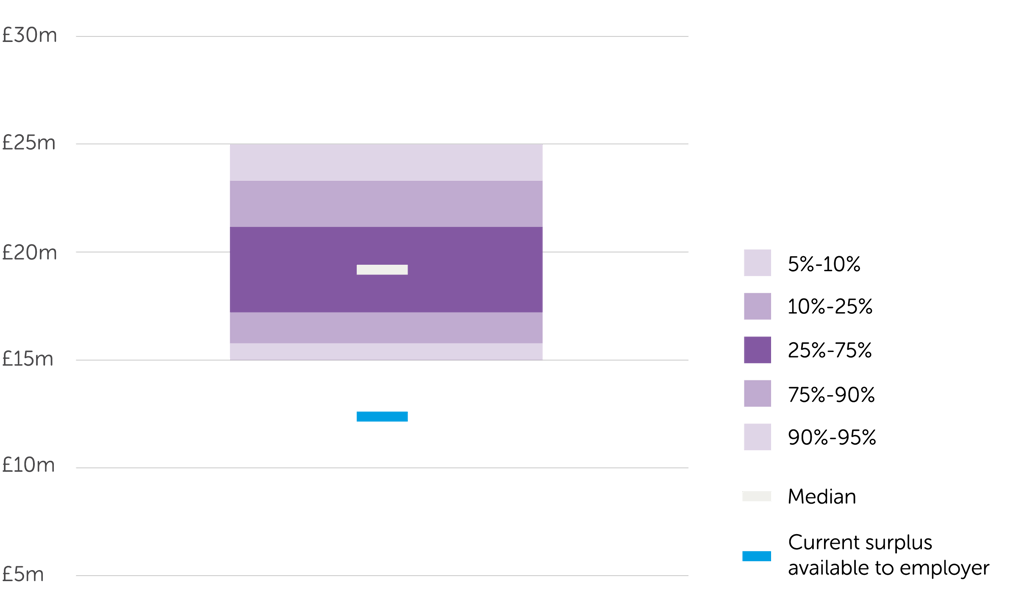
We have developed a framework based on well-established corporate finance techniques that provides decision-makers with the information needed to assess the benefits of running on relative to an immediate buyout, ensuring the full financial implications are properly analysed, understood and decisions are optimised.
For around two-thirds of DB schemes sponsors, running on would be the financially optimal strategic decision.
67%
Our analysis of FTSE350 companies showed for around two-thirds (67%) of DB schemes sponsors, running on would be the financially optimal strategic decision. In these cases, the net present value of the scheme to the company was maximised via running on for a period of time, rather than buying out at the earliest possible moment. The results suggested that running on is likely to be a more financially attractive strategy than an immediate risk transfer for larger, less mature schemes with stronger sponsors.
Of course, any closed scheme will mature over time and will contract as benefits are paid out – so even if run on is the right strategy today, there will come a time when a risk transfer makes more sense. Understanding this timeline is important for strategic planning, especially around transaction readiness and the appetite for less liquid assets.
From strategy selection to execution
Delivering a successful pension strategy requires more than just selecting the right destination – it depends on the ability to execute effectively and with control.
We have set out below the key elements for corporates to consider when designing the framework for executing pension strategy successfully.
Trustee governance model
Investment operational model
Budgeting and costs
Trustee governance model

Leanne Carpenter
Business Development Consultant
Trustees are the ultimate decision-makers for DB schemes and often hold the keys to the strategy.
It is therefore essential to ensure the trustees are strongly aligned with the effective delivery of the corporate’s strategy. Both parties working towards a common goal will improve results, while misalignment is likely to result in delays, increased costs and suboptimal outcomes.
A range of trustee governance models are now available, with suitability depending on scheme size, complexity and strategic objectives. Corporates should ensure the trustee board has the right mix of skills, experience and capacity to execute the strategy effectively. This may be achieved through:
A traditional trustee board (combining employer-nominated and member-nominated trustees)
The appointment of a professional trustee (as co-trustee or chair) to bring wider expertise
A corporate sole trustee to accelerate decision-making and projects.
Professional trustees often enhance governance by bringing specialist expertise (for example, in relation to the company’s specific strategic objective), industry knowledge, transaction experience, and supporting more informed and timely decisions.
Results from our 2026 professional trustee survey
Click on bars to see more detail
Appointments
66%
Recommendations
97%
Corporate sole trustee model
25%
“Having the right professional trustee on your scheme can improve decision making, strategic oversight, collaboration and bring technical expertise. It is important to find the right fit for your scheme as personality and skill set is key. We have strong relationships with the whole trustee market and specialise in helping schemes find the right candidate for them. Our process incorporates a high level of due diligence, governance and expertise.”
Leanne Carpenter
Business Development Consultant

Investment operational model

Peter Daniels
Head of Outsourced Investment Services
A scheme’s investment strategy is a key driver of both the level of risk borne by the sponsor and the overall cost of providing member benefits.
Whilst trustees are responsible for setting the strategy, they are required to consult with the sponsor on material changes, reflecting the direct financial implications for the business.
Corporates have a clear interest in ensuring the investment strategy and operational model are subject to robust governance and oversight, are aligned with broader objectives, and deliver value for money. This requires an appropriate and well-defined advice and operational framework, within which investment strategy and its implementation are subject to effective scrutiny. Corporates should ensure that trustees receive high-quality advice that is clear and transparent, and that trustee decision-making processes are sufficiently robust to test both the strategic rationale and practical implications of proposed changes.
A high-performing investment strategy will target a return that is aligned with objectives, minimise risk and ensure sufficient liquidity when needed. Corporates should ensure these key strategic elements are being optimised by their trustees and pension scheme advisers.
It is important that the operational model remains aligned with the scheme’s objectives. The level and form of delegation of asset management responsibilities - whether to fund managers, fiduciary managers or OCIO providers - should reflect the scheme’s size, complexity, journey plan and proximity to endgame. For example, as schemes approach buy-in or buyout, it may be appropriate to challenge whether more complex and higher-cost arrangements remain justified or whether a simpler structure would achieve similar outcomes more efficiently.
Overall, corporates should take an active and informed role in understanding and influencing the scheme’s investment operational model, ensuring that it supports effective decision-making, clear accountability and value for money relative to the company’s broader risk and financial objectives.
“In an environment of increasing optionality in investment approach, the alignment of strategy, governance and operational delivery has never been more important for corporate sponsors seeking to balance risk, cost and long-term outcomes.”
Peter Daniels
Head of Outsourced Investment Services
Budgeting and costs
DB scheme cost management is the final component for corporates to consider while executing the strategic objective - a particularly pressing issue in the current environment, where a number of sectors are experiencing cash constraints.
Main costs sponsors are concerned about
Asset management
43%
Administration
37%
Advisory
37%
Whether or not DB scheme costs are paid directly by the company, the company is ultimately bearing the burden of these costs as they erode the value of the assets over time. Corporates should therefore work with the trustees to ensure full transparency over costs and put controls in place to ensure these are managed appropriately.
As well as explicit advisory and administration costs, companies should also be aware of implicit DB scheme costs, such as investment management expenses, which can be material and often pass under the radar due to the charging structure. Project costs are also likely to be a material component of a DB scheme’s expenditure, particularly where a transaction is being planned, so the corporate should ensure these are delivering value for the costs incurred.
An independent adviser can play an important role by providing objective challenge on scheme running costs, helping to ensure fees are reasonable, competitive, and aligned with outcomes.

Making a confident choice
The DB market has entered a new era of choice, but with greater choice comes greater complexity.
Insurance buy-in/buyout, superfund transfer and intentional run-on each offer a different balance of risk, cost and potential value, meaning there is no single "right" strategy. The optimal approach will depend on the specific circumstances, objectives and risk appetite of both the scheme and its sponsor.
In this environment, successful sponsors are likely to be those that take a structured approach to evaluating their options, understand the trade-offs involved and remain willing to adapt as circumstances change. Equally important is having a clear plan for execution. Whether pursuing insurance, superfund transfer or run-on, thorough planning, strong governance and careful budgeting will ensure that the chosen strategy is delivered effectively and with control.
Calculation details: The data used for this analysis has been collected from the accounts of FTSE 350 companies for their 2025 year ends (i.e. up to and including the year ending 31 December 2025). Liability values on a buyout basis have been estimated by approximately updating these results and using Barnett Waddingham's view of average buyout pricing. Asset values have been estimated using index returns and the asset split disclosed in the pension disclosures.